In S. Mufwene , J. Rickford, J. Baugh and G. Bailey (ed.),
The Structure of African-American English,
London: Routledge.1998. Pp. 110-153.
Coexistent systems in African-American
English
William Labov,
University
of Pennsylvania
This contribution to the study of African American Vernacular English [AAVE] is an interpretation of the special linguistic features of this dialect in the light of its co-existence with other co-territorial dialects of English. It is far removed from the notion that AAVE can be seen as a system in itself, analyzed without reference to other dialects, which has been repeated theme of research in this area from the very beginnings to the present day. Although it must be admitted that this monolithic approach has often produced descriptions that are far removed from linguistic and social reality, it has also been a continued source of insights, bringing to our attention striking differences between AAVE and other dialects that would otherwise have been overlooked. In fact, this analysis I am presenting here is heavily indebted to two linguists who have attempted to extract an invariant core that is unique to AAVE, the earliest and the most recent contribution to the study of this dialect. One source is the work of Beryl Bailey, who brought to AAVE the insights from her description of Jamaican Creole English, drawn from her internalized knowledge as a native speaker. The recognition of my indebtedness to her work was the original motivation for this paper. The other source is the monumental study of the tense and aspect system of AAVE by Elizabeth Dayton, begun in the 1970's and only recently brought to completion. Dayton's meticulously transcribed observations are the product of many years of participation in the daily life of a Philadelphia African American community, Her data on the tense and aspect particles of AAVE, carefully noted in the midst of the social interactions that produced it, is roughly ten times as large as all the combined observations of all other researchers. In the original version of this paper, written five years ago, I drew upon a number of handouts form unpublished papers that Dayton had given throughout the years. In revising this paper, I have not attempted to re-incorporate the massive data and extensive analyses of her 1996 dissertation. I hope that the point of view developed here will continue to be useful in the years to come, when the linguistic community has begun to assimilate Dayton's data and her analysis of the AAVE system.
0. The heritage of Beryl Bailey
My first acquaintance with the issues raised in this paper came through my close association with Beryl Bailey, who was a fellow student with me at Columbia.[1] Both of our dissertations were directed by Uriel Weinreich, who encouraged us to apply the tools of linguistics to the language of every-day life, and to set aside the barriers between linguistic analysis and dialectology. Beryl came from a school teacher's family and a school teacher's world. For many Jamaicans, that means cleaving to the standards and norms of school teachers, and never looking back at the life and language of ordinary people. Beryl wrote in her introduction that she wanted to
explode once and for all the notion which persists among teachers of English in Jamaica, that the 'dialect' is not a language: and further that it has no bearing on the problem of the teaching of English.
She began work on Jamaican Creole English in 1956, made several return trips to Jamaica, and produced a language guide to Jamaica to help train Peace Corps volunteers. Her dissertation, Jamaican Creole Syntax, appeared in 1966; was the first comprehensive description of a Creole syntax. It is also an important point of reference for the structure of African-American Vernacular English [AAVE] in the U.S. To get some insight into Bailey's style, and the tradition she came from, one might simply cite her dedication:
to the memory of my
great-grandfather
Henry Loftman
whose passion for the
rudiments of English grammar
earned him the nickname
'syntax.'
Bailey's view of AAVE
Bailey's approach to AAVE is exemplified in her first paper on the topic, "Toward a new perspective in Negro English dialectology" (1965). Her insights into the nature of the dialect were motivated in part by her reaction against the dialectological view of AAVE as a collection of mistakes or deviations from Standard English. Outside of the school setting, Beryl was not a field worker, and her whole article was based on an examination of the speech of the narrator in one novel, The Cool World. She apologized for this fact in words that are worth citing:
(1) I was compelled to modify the orthodox procedures and even, at times, to adopt some completely unorthodox ones. The first problem that I had to face was that of abstracting a hypothetical dialect which could reasonably be regarded as featuring the main elements of the deep structure. This may sound like hocus-pocus, but indeed a good deal of linguistics is. A hocus-pocus procedure which yields the linguistic facts is surely preferable to a scientifically rigorous one which murders those facts.
Bailey's main theme is that AAVE must be understood as an independent structure in its own right. The most remarkable result of her analysis is the following set of three phrase structure rules for non-verbal predications:
[1](2)
English predications
P Æ be +
(3) Jamaican Creole predications
P Æ
(4) Cool World predications
P Æ ÿ +
It should be clear that Bailey anticipated in this juxtaposition the long discussion of the AAVE copula to follow. The separation of the copula from the progressive auxiliary has since been recognized as a useful strategy (G. Bailey and N. Maynor 1989). Her abstraction from the Cool World data of a grammar with categorical absence of the copula did not prove to be characteristic of AAVE, but this type of structure has recently re-appeared in John Singler's description of the mesolect in Liberia (1991).[2] Most importantly, she identified a family resemblance between AAVE and JCE which was the basis of most of the research that followed.
1. The recognition of separate systems
Though Bailey did not study every-day speech in JCE or AAVE, she was well aware of variation that did not fit within the rules of her grammar. Following the logic of her basic methodology given in (1), she assigned the variation of every-day speech automatically to interference from another language (or dialect), which one might call Standard English or Jamaican Standard English. This approach to the resolution of variation has been put forward frequently from the very beginning of studies of variation and change. It has been suggested as a way of handling the variation of constricted and non-constricted /r/ in New York City, or the variation of fricatives, affricates and stops for the interdentals (dh) and (th). The resolution into separate dialects is in fact the limiting case of the general solution to the problem of variation. One begins with a surface variation, say between [kAˇd] and [kA:¥d], or between He's tired and He tired. The analytical task is to discover what this surface variation reflects in the organization of the grammar: mere phonetic variability, variation in a more abstract phonological rule, the variable insertion of a morpheme, the alternation of allomorphs, variation in the syntactic parsing or syntactic movements, or in many cases the combined effects of morphological and phonological variation (Guy 1981). The limiting possibility is that the surface variation is caused by the alternating use of two separate systems, each comprising in itself a complete and coherent grammar. The crucial question for the general study of variation is to decide what kind of evidence bears on the assignment of variation to what level, and what kind of evidence could justify the recognition of distinct systems, not simply competing rules.
The issue of where variability is located in the grammar has been given a new impetus by Mufwene (1992), in a general argument for the recognition of heterogeneity in linguistic systems. In discussing the AAVE copula, he attributes the variation found in the actual realization of Bailey's rule (4) not to phonological contraction or morphological insertion, but to a fundamental difference in the basic phrase structure rules of the grammar:
(5) Unlike Standard English, BE allows both S ã> NP VP and S ã> NP PredP as alternative surface combinatoric rules in its non-elliptical clauses. . . . Those speakers producing copula-less sentences more frequently may be assumed to subscribe predominantly to the S ã> NP PredP rules and the others to the S ã> NP VP rule. There is undoubtedly individual variation among BE speakers regarding whether the second rule is favored when the PredP is headed by an adjective or by a preposition.[3]
In arguing for such an assignment, and against contraction and deletion rules, Mufwene refers only to one set of constraints: the following grammatical environment. But the crucial evidence for the alignment of the AAVE auxiliary and copula with that of other dialects is found in parallel effects of the form of the subject. Both contraction and deletion are favored by subject pronouns as against full noun phrases, reflecting a long-standing pattern in the history of English (G. Bailey, Maynor and Cukor-Avila 1989). More importantly, contraction and deletion are inversely affected by the phonological form of the subject: vowel-final subjects favor contraction and consonant-final subjects favor deletion, as one would predict from the unmarked status of CVC syllables.[4] Phonological constraints of this type indicate that the object being acted on is in place at a higher level of abstraction, and that its alternation with zero is controlled by a phonological rule (Labov 1987). But even if Mufwene's concept ofa heterogeneous grammar should not apply to the variation of finite BE -- which I will view here as a part of the general English component of AAVE -- I will argue that the situation is fundamentally as he describes it: the grammar is characterized by two sets of non-overlapping and structurally inconsistent rules.
The major topic of this paper ã the tense and aspect systems of AAVE and OAD ã will show many differences that reflect a higher level variation comparable to that suggested by Mufwene. The questions to be addressed will concern contrasts like He be tired vs. He tired. There has never been any reason to believe that this is the result of a low level rule of phonological deletion of be. The issue is whether these two forms differ only by the optional choice of the aspect marker be, or whether the choice of invariant be vs. finite be reflects an alternation at a higher level that involving layered sets of rules.
The discussion to follow will pursue the suggestion of Labov 1971 that the recognition of a linguistic system as a separate entity depends upon the strict co-occurrence of sets of rules. In the simplest schema (6), a community may show variation involving two rules, A and B, which may apply or not apply in four different possible arrangements for various sub-groups:
{1} {2} {3} {4}
(6) Rule A applies yes yes no no
Rule B applies yes no yes no
If all four possibilities occur, then the choice of A is independent of the choice of B, and there is no evidence for a separate system. We can recognize two separate and independent variable rules. But if we find only possibilities {1} and {4} and never {2} and {3} then we can say that rules A and B are in some way dependent on each other or upon some more abstract choice. In this sense, they are linked systematically, and form part of a (possibly larger) separate system. It is just such linking or co-occurrence of properties that we will search for in re-opening the question of coexistent systems in AAVE.
2. The current consensus on AAVE.
Given the active state of research on AAVE, and the impeding impact of Dayton's work, any attempt to state a general consensus can only be momentarily successful; the following brief account is my own effort to update the effort of Labov 1982 in this respect.[5] For this purpose it will be useful to compare AAVE with all other dialects of English spoken in the continental U.S.: I will refer to these as Other American Dialects, or OAD. While there is considerable variation within this range of "other dialects", particularly within the Southern States, it can still be argued that they share many features in common and are differentiated as a whole from AAVE.[6] The term AAVE or African-American Vernacular English will be used to refer to what was earlier called the Black English Vernacular, as defined by Baugh (1983): the uniform grammar used by African-Americans who have minimal contact with other dialects in contexts where only speakers of that vernacular are present.
It is logical to group the findings that relate AAVE to OAD into three sets. One set shows a great area of similarity between AAVE and OAD; another set shows discrete and categorical absence in AAVE of certain elements of OAD; the third finds elements of AAVE that do not exist in OAD. In short, the common, the negative, and the positive.
The common area is by far the largest. The most striking features of AAVE syntax are shared by white Southern States dialects used by white speakers: negative concord, negative inversion, lack of inversion in embedded questions, double modals (Labov et al. 1968, Wolfram 1974, Feagin 1979, Boortien 1979, Di Paolo 1989). AAVE and OAD share most categorical rules, and for variable rules, differ only quantitatively, not qualitatively. In the noun phrase, there are no significant differences in the expression of person or number, and the category of possession is intact.[7] AAVE and OAD show no differences in the forms or semantics of the past tense, or the general present, and only small formal differences in the future. The past perfect is used regularly in AAVE, though its form is occasionally borrowed in preterit uses.
AAVE also uses the same basic set of aspects as OAD: the progressive be + ing and the present perfect, have + en. The only observable differences in the use of the progressive are some differentiation in the constraint on its use with stative verbs. In AAVE, the present perfect has an uncertain status in the positive, but is used consistently in negative sentences. The past perfect can be used in the same way as in OAD, but as it has appeared with increasing clarity, it is also extended to serve as a simple preterit (Labov et al. 1968:225 Rickford in press, Cukor-Avila 1995, Dayton 1996).
AAVE shares with OAD the basic categories of mood--indicative, imperative, subjunctive, the same modals, and voice--active, passive, middle, causative, with only slight differences in form.
The second set of findings are concentrated in morphology, and those areas of syntax that intersect with morphology. The possessive morpheme in attributive position is absent. There is no third singular /s/ in AAVE and no subject-verb agreement, except for the copula.[2][8]
The third set of findings concern a series of auxiliary particles found in AAVE but not in OAD: be, done, be done, been done, been, steady, come. The semantics and syntax of those particles show only small overlap with elements found in OAD.[9]
There are several recognized ways of bringing these three sets of observations to bear on the present-day relations of AAVE and OAD.
a. AAVE and OAD can be seen as separate languages or dialects, and variation as code-switching between them. This is the position of Beryl Bailey cited in (1) above.
b. AAVE and OAD can be seen as systems that are distinct but interdependent. This is the notion of coexistent systems introduced by Fries and Pike 1967, who used it to characterize a phonological sub-set that had entered the language with Spanish loan words. In this concept, one of the two systems may not be a complete or independent entity, capable of generating a complete range of utterances, but merely a sub-set that is used to supplement or combine with the other. This concept has been further refined by the various senses of ≥non-monolithic≤ developed in Mufwene 1992
c. AAVE can be seen as a mesolectal stage in the upper part of a Creole continuum, in which the standard variety of OAD is the acrolect(Bickerton 1975). In such a continuum, there may be an implicational scale that will rule out {3} in (6) above, but not {2}. Thus not all combinations of rules are permitted, but there is no strict co-occurrence rule that links rule A automatically to rule B.
d. AAVE can be viewed as a de-creolized dialect of English with the many persistent Creole-like features embedded in it. Descriptions of AAVE written from this perspective (Stewart 1971, Dillard 1972) did not as a rule consider variation, but follow implicitly the line of (a) above.[10]
One
might argue for a more sophisticated combination of b, c and d, combining
synchronic and diachronic perspectives (Rickford, p.c.). The hypothesis to be
advanced here is focused directly on (b), the recognition of coexistent
systems. It is proposed that AAVE consists of two distinct components. the
General English [GE] component , which is similar to the grammar of OAD, and
the African-American [AA] component . These two components are not tightly
integrated with each other, but follow internal patterns of strict
co-occurrence. On the other hand, they are not completely independent
structures. On the one hand, GE is a fairly complete set of syntactic,
morphological and phonological structures, which can function independently.
Through the GE component, speakers of AAVE have access to the much the same
grammatical and lexical machinery as speakers of OAD, and use it for the much the same range of grammatical
functions. On the other hand, the
AA component allows speakers of AAVE to construct sentence types that are not
available in OAD. The AA component is not a complete grammar, but a subset of
grammatical and lexical forms that are used in combination with much but not
all of the grammatical inventory of GE in ways that to be explored below. In
the end, we will see that the distinct positive features of AAVE in this AA
component are free to develop a specialized semantics that is used primarily in
highly affective, socially marked interactions.[11]
Thus the AA component may be seen as an addition to the GE component, in some
ways complementing the OAD elements that have been subtracted or were never
present in AAVE. The GE component then serves as a set of default values for
AAVE: when no AA element is supplied, the GE component is used. The AA
component is concentrated largely in a set of aspectual particles and their
semantic structures.
3. The African-American components of the tense-aspect system.
I will now examine briefly the development of the AA aspectual particles, following the work of recent scholars who have described with some precision their distributions, use and meanings within the social context of the vernacular African-American community. I will be drawing heavily on the long-term participant observation of John Baugh in Los Angeles and Elizabeth Dayton in Philadelphia. These grammatical particles cannot be studied in the same way as the closed sets of the GE component: [12] they are marked elements whose non-occurrence is not easily quantifiable, and their use is concentrated in the kind of face-to-face interaction which requires direct observation of the participant-observer.[13]
These particles -- be, been, done, come, steady -- are all invariant forms, which are placed before the main verb of the sentence in the positions reserved for modals or aspectual markers in OAD. They are clearly grammaticalized markers and distinct from the homonymous main verbs or adverbs in several respects that are typical results of grammaticalization.[14] In these respects, they are typologically similar to the tense and aspect particles of Caribbean Creoles: Jamaican a/de, (b)en, done; Haitian ap, pe, te. (Spears 1990, Lefebvre et al. 1982). As we will see, they do not participate in any of the syntactic operations associated with INFL: auxiliary inversion, neg-placement, tag questions, or cliticization on the subject. In these respects, the AA particles share properties with the Afro-Caribbean grammars of Creole languages, and it was only natural for linguists following the Beryl Bailey tradition to see them as the direct continuation or the inheritance of a similar Creole grammar spoken on the U.S. mainland in the 18th and 19th centuries (Dillard 1972, Stewart 1967, 1971). However, the relation of BEV to Creole grammars of the Caribbsean appears in a very different light as the result of a number of the findings of recent research (G. Bailey & N. Maynor 1987, 1989, Rickford & McNair-Knox 1993, Dunlap 1977, Poplack and Sankoff 1987, Poplack and Tagliamonte 1989, 1991, Myhill 1988, 1991, Edwards 1991, Montgomery, Fuller and Paparone 1993). These various sources give varying degrees of support to the main thesis of Bailey and Maynor 1991, which can be summed up in two statements:
a. The particular form/meaning combinations of the AAVE particles are quite different from those found in the Caribbean.
b. The grammar used by African-Americans in the South in the 19th century did not show these patterns, but rather a grammar much closer to that of OAD.
The general conclusion that is emerging from studies of the history of AAVE is that many important features of the modern dialect are creations of the 20th century and not an inheritance of the 19th. The Creole affinities of AAVE and the Creole-like structural properties that we do observe are not to be accounted for by direct transmission, but by the more subtle process of substrate influence and by parallel drift or development. This view of the situation is presented as the best working hypothesis to date, certainly not one that is established beyond challenge. If we accept for the moment that AAVE has diverged in many respects from OAD in recent decades, and is continuing to diverge, we tend to draw different conclusions about the structure of the dialect.
Non-finite BE.
The particle be is the most frequent and the most salient of the AA elements in AAVE. Its morphology is clear: it always appears as /biy/ (and occasionally with an /s/ suffix[15]). It shows three syntactic properties that distinguish it sharply from GE auxiliary elements:
a. It does not accept negative affixation (*ben't or *be not). Instead, the negative particle precedes be and requires do support(don't be...).
b. It does not form tag questions (*..., be he?).
c.
It does not participate in auxiliary inversion (*Be he doing that?)
These three properties will be referred to as the non-finite syntax of be, a set of properties shared by all of the AA particles to be discussed below. This non-finite syntax of AA particles is the chief evidence to be advanced for the heterogeneous character of AAVE, since the central mechanisms of GE auxiliary syntax are missing, and with them much of the motivation for attributing the same structures to sentences with AA auxiliaries as GE auxiliaries.
Further
evidence for the non-finite character of be and other AA particles is found in their semantic behavior. Dayton has
demonstrated that the AA particles be, done, be done are
free of any limitation to past, present or future time. It is well known that be occurs in future contexts; in early work, these
were set aside as indicating possible deletion of contracted will:
(7) When June come, I be outta school and outta work.
[Dayton 1986].
Similarly, contexts with past habitual behavior were set aside as indicating a possible deletion of contracted would:
(8) When they used to tell us that the nipples be pink on pregnant women, we be laughin'; we were laughin' 'cause it don't be like that. [Dayton 1986]
However, Dayton gives many examples of such forms following noun phrases ending in consonants, where contraction is not possible, as in (9):
(9) When my son was young, the women be givin' him money.
[Dayton 1986]
These and many other sentences all lead to the conclusion that non-finite be carries no tense information. Most sentences with be do co-occur with verbs referring to present situations, since that follows from its aspectual characterization of 'habitual' behavior, but there is no bar to it appearing in any temporal context. The same argument will be repeated for all AA particles.
The
non-finite syntax and semantics of AA auxiliaries might indicate continuity with or affinity
with the Afro-Caribbean mesolectal grammars that share these properties. The
evidence for discontinuity and divergence rests upon the particular combination
of form and meaning involved. The central meaning of 'habitual' was recognized for non-finite be very early in studies of AAVE (Stewart 1967, Labov
et al. 1968, Fasold 1972), and there is little disagreement about this. There
has however never been any clear agreement on whether non-finite be is opposed to finite be as a privative opposition. If this were the case,
"He talking about you" would mean 'at the moment' and could not mean
'habitually.' We often find a free alternation of non-finite be and finite is/am/are. For example,
from the adolescent Jets in New York City:
(10) Like--...she be standin' with her hand in her pocket, and her friend is standin' there, and a man is messin' with her friend. [member of the Jets, 16; Labov et al. 1968]
When it was first realized that non-finite be had a habitual meaning, it was natural to connect this with the 'habitual' or 'iterative' aspect of Caribbean creoles.[16] However, comparatively few creoles have a specialized marker for habituals. Some use the same non-punctual marker to indicate both progressive and habitual, while others merge the habitual and the future (Taylor 1977, Holm 1988). Some English creoles show a specifically habitual marker doz in the present and useto in the pst: in Trinidad (Winford 1992), Guyana (Rickford 1980), Barbados (Burrowes and Allsop 1983), Mosquito Coast Creole English (Holm 1978). Invariant be is rare in the Caribbean, but is a common feature of Hiberno-English and other English dialects, sometimes in combination with do as do be or does be, but also alone. The 'habitual' meaning makes a direct link with the Irish habitual copula, or "consuetudinal be". Evidence on the origin of the invariant be form is not conclusive in either direction, and may indicate a convergence of several forms of contact. Rickford 1980 demonstrates a route by which Gullah doz be gave rise to a reduced be form, and Rickford 1986 sums up the evidence for early contact of black speakers with Irish laborers.
In any case, the historical origins of nonfinite be are not as relevant to the main theme of this paper, the current trajectory of AAVE, as the intricate semantic development of this particle in recent times. The semantic range reported by studies of the vernacular over the past twenty years is quite different from anything reported so far for Caribbean a or de. To begin with, it is now clear that the association of iterative and habitual, common in describing Caribbean Creole grammars, was mistaken. Dayton has conclusively demonstrated that there is complementary distribution in this respect between be and done. Adverbs that indicate indefinite, habitual behavior like always, all the time, every, sometimes, and steady co-occur regularly with non-finite be in AAVE.
(11) When you don't be talkin' about someone else all the time.
[member of the Jets, 16; Labov, Cohen, Robins and Lewis 1968]
On the other hand, adverbs that indicate iterated behavior like twice and five times co-occur with done (see below). The differences are almost absolute in Dayton's extensive data.
This specialization of the meaning of be is only one indication of the idiosyncratic semantic development found in AAVE. From the first observations of be, it was clear that there are some utterances that do not fit into the category of 'habitual.'
(12) So you know it all don't be on her; it be half on me and half on her.
[12-year-old girl, in Chicago, 1965]
While (12) might be interpreted as habitual behavior, it was not intended as such; rather, it dealt with the attribution of blame for a particular incident. Such utterances almost always indicate a durative state of affairs, usually accompanied by an intensive quality. This is particularly evident in (13), said by a woman in the University of Pennsylvania hospital to another woman in a conversation of an intensely religious character:
(13) Her Father be your Father.
The steady state character of (13) is also found in (14), called out by a man leaning out of a truck in West Philadelphia to a woman on the sidewalk:
(14) Hey baby, this be Heywood!
A fair number of such utterances collected over the years indicate that non-finite be has developed the capacity to refer to extended steady states, usually indicating a higher state of reality than normally predicated. This affective quality can be thought of as the super-real, or surrealis, as contrasted with the irrealis category that unites futures and modals as referring to a state of affairs that is less than real.[17] This surrealis feature is found in a number of AA elements, as will be evident in the discussion to follow. However, it should be noted that such highly affective utterances form only a part of the uses of invariant be that fail to show habitual or durative aspect. For this reason, Dayton argues that the semantic core of invariant be is stativity, opposed in this respect to done within the aspectual system.
Before these special semantic developments of the nonfinite be occurred, one might suppose that there was a simple habitual, perhaps a habitual/iterative category that was the modern continuation of an Anglo-Irish or Caribbean category. This supposition is difficult to maintain, however, in the light of the evidence presented by Bailey and Maynor that the habitual feature of nonfinite be is a development of recent times, following the great migration of southern rural blacks to urban centers (Bailey and Maynor 1985a,b, 1987, 1989, Bailey 1993). Their repeated studies show that "children and teen-agers, especially those with urban connections, generally use [nonfinite be] +V+ing to mark durative/habitual actions while the older adults never do" (Bailey 1993:303). In the earlier pattern, reflected in the narratives of ex-slaves as well, nonfinite be appears to have been an alternate of finite be, with similar syntactic and semantic distribution. The work of Rickford and his associates in East Palo Alto shows a similar recent increase in the frequency of nonfinite be and its habitual pattern (Rickford and McNair-Knox 1993). Rickford 1992 argues that the change is primarily a quantitative one: that the sentences cited from older rural speakers show evidence of the habitual feature. However, Bailey 1993 demonstrates that the growth of habitual be + ing is a qualitative break: that use of invariant be + ing to mark habitual aspect is found among all urban speakers born after 1944 and rural speakers strong urban ties born after 1944, while none of the speakers born before 1944 use this feature. The demonstration that habitual be is a creation of the second half of the 20th century is typical of the many findings of sociolinguistics which completely reverse previous expectations. Despite the many objections that have been raised by those who cling to the older conception, the evidence brought to bear in Bailey 1993 is overwhelming; seldom has the case for abrupt linguistic change been more decisively argued.[18]
Thus the recent history of the first of the AA particles, nonfinite be, provides a sharp challenge to our understanding of the nature of modern AAVE. The farther we come from a common origin with the Caribbean Creole populations, the more similarity we find to Creole grammars in the tense and aspect system. But this similarity is not the precise correlation of forms and meanings that forms the essential evidence for historical linguistics. Rather it is a typological similarity of the sort that provides relatively weak evidence for historical reconstruction. This puzzling situation recurs in the study of other AA elements of the dialect.
Perfect DONE
AAVE has always possessed the perfect particle, done, which is found in both in white Southern States English and in Caribbean Creoles. In AAVE, done precedes a verb that makes reference to an action completed in the recent past. If that is a telic verb, which implies a change of state, done will indicate that the action is completed. Thus in (15) and (16), the verb use must mean 'use up' in combination with done:
(15) You don't have it 'cause you done used it in your younger age. [Isolated individual, 15, South Harlem, 1966]
(16) It don't make no difference, 'cause they done used all the good ones by now. [Baugh 1983]
The second common semantic feature of the perfect ã relevance to the present ã is usually implicit. But in both (15) and (16) current relevance is foregrounded, since done is attached to subordinate clause of causation which explicitly states that this event is a cause of the event of the main clause. In (17), this connection is implicit: so might be inserted before le's run.
(17) We done got this far; le's run!
[member of the Oscar Brothers, 15, South Harlem, 1966]
When done modifies a punctual verb like tell, the sense of 'completion' is neutralized; one does not 'completely tell' someone something. It is then equivalent to 'occurrence in the recent past, with effects on the present', and can be translated as 'already.' Indeed, done commonly co-occurs with already. (18) and (19) were spoken by the same person on the same occasion.
(18) I done told you on that.
(19) I done told you already.
[member of the Jets, 13, South Harlem, 1966]
Among adults, one often finds done alternating with the GE present perfect have + en, showing that for some AAVE speakers this GE form can be an equivalent of the English present perfect. The meaning of 'effect on the present' characteristic of the present perfect then emerges, not only for tell in (20) but also for get wet in (21), which can accept the meaning of 'completive.'
(20) But you done tol' em, you don't realize you d--you have told 'em that. [South Harlem, 39, 1967]
(21) Buff, I done got wet twice goin' to the store. (What?) I have gotten wet twice; that's how hard it's rainin'. [Dayton 1984]
When done is used with iterative adverbs like twice , the 'completed' meaning can be suspended for each individual event; in (21), the speaker need not have gotten thoroughly wet and dried out each time. The 'completeness' of the action is translated into its iterative character; it is not so much the completeness of the action as the high degree of change of state that has an effect on the action.
This
use of done with twice illustrates
an important development which Dayton discovered in the semantics of this
particle. As mentioned above, done
co-occurs with iterative adverbs like twice, five times, but be does not. Thus it is reasonable to oppose AAVE done to be
as [+definite] to [-definite].
In AAVE, as in many languages of the world, perfect aspect develops an 'intensive' meaning. In (22), done shows the stereotypical use of intensive done where the sense of 'completion' is pushed into the background.
(22) Well, we useta get into trouble and . . . y'know . . . like . . . if Pop'd catch us,, he say, "Boy--you done done it now.
[Baugh 1983]
Done is frequently used with other verbs that do not easily accept the notion of 'completed.' The verb win is such a punctual act; (23) does not gracefully accept a translation with completely.
(23) After I done won all that money.
[Member of the T-Birds, 12, South Harlem, 1965]
In (24) , the action of get the works is in itself completive, and done is best seen as carrying an 'intensive' meaning. From the speaker of (18) and (19):
(24) After you knock the guy down, he done got the works, you know he gon' try to sneak you.
[Member of the Jets, 13, South Harlem, 1966]
We find in addition that AAVE has developed new uses of done which cannot be characterized as either a 'completed' meaning or 'intensive'. Done can precede a verb that refers to a socially defined act that cannot be done completely or intensively:
(25) He
done slept with Francine and he done slept with Darlene... and he supposed to be a good
friend of Henry [Darlene's husband, from W. Philadelphia.]
Sleeping with someone is an action that is defined by society as either done or not done: it can't be done partially or completely, intensively or moderately, so the meaning of done is not transparent in this case. A similar problem is found in (26), which also concerns a man who was cheating on his wife. In this case, done is used as a modifier of the socially punctual action of going to work.
(26) So he went to where she was. . . and got the nerve to lie to me . . talking 'bout he done went to work. [Baugh 1983]
What is the meaning of done in (25) and (26)? Speakers of AAVE generally agree that done here resonates with the sense of moral indignation, and can be translated by the phrase 'had the nerve to', which appears explicitly in the matrix sentence in (26). This interpretation also applies directly to (25). But in (26), moral indignation is not directed to the act of going to work but to lying about going to work; we then have to assume that done is associated with the higher verb talk in the underlying form, and has been lowered to its present position before went.
Whenever we find such extended meanings of a grammatical particle, one must consider the possibility that they are "contextually pragmatic interpretations" (Winford 1993), and not meanings within the grammatical system. There is no general criterion for deciding when a particular interpretation has been grammaticalized and is now a part of the fundamental meaning of the particle. However, we must be prepared to describe, at least informally, the rules of interpretation that take us from 'completed' or 'intensive' to 'moral indignation.' I do not know of any pragmatic analysis that would carry the done of (25) from 'intensive' to 'morally undesirable' rather than to 'thoroughly', 'magnificently' or 'spectacularly'. One might say that the presence anywhere in the context of moral disapproval, no matter how generally derived, will select the 'moral indignation' sense of done. If such a rule operated generally on any particle meaning 'completed' or 'intensive' it would produce such an interpretation from "he told her he already went to the office" or "he told her he really went to the office." In the absence of any evidence for such a rule, we must assign 'moral indignation' as one of the selectable elements of the meaning of done in AAVE.
Since done is used in Caribbean English-based Creoles as well as in AAVE, we can benefit from the opportunity to contrast the syntax and semantics of the particle in AAVE and a particular Caribbean community. Edwards 1991 provides a penetrating and insightful review of the semantics of done in Guyana, based on his own recordings in 1974 and a review of the literature.[19] He recognizes the arguments of Feagin (1979) and Wolfram and Christian (1976) that AAVE done is related to the done of white Southern States English. But he maintains that the semantic similarities of the Guyanese and AAVE form lead to the conclusion that "preverbal done is a decreolized variant of Caribbean creole preverbal don." (p. 253). He provides a set of observed sentences that show Guyanese don translatable as 'already,' referring to a state of affairs in effect prior to the moment of speaking, and still in effect at the moment of speaking, as in (27):
(27) Bai taim mi lef de fu kom hee som a dem don marid.
'By the time I left there to come here some of them were already married.'
(28) Dem don gat di koolii-man rom.
'They already have the Indian man's rum.'
Another type can be glossed as 'be finished.'
(29) Somtaim wen you don wok yu go an bai a dringk.
'Sometimes when you [are] finished working you go and buy a drink.'
Edwards' over-all portrait of the semantics of Guyanese don shows a marker of perfect aspect that embodies location in the past, completion and current relevance. In these respects, it resembles AAVE done. But Edwards also points out many features of Guyanese don that are quite different.
ÄGuyanese don occurs with statives as well as non-statives; sentences of type (27-28) occur with statives, sentences of type (29) with non-statives. But AAVE done occurs only with non-stative verbs.
ÄGuyanese don also functions as a non-stative main verb with the meaning of 'finish'; though some of these sentences are equivalent to AAVE forms with deleted copula, others cannot be so translated.
(30) Yu kyan don baut trii, akaadin to hau yu plant.
'You can be finished around three, according to how you plant.'
When main verb don combines with preverbal don, we get
(31) He
don don. 'He is/has already finished.'
(32) Mi bin don don wen Jaan kom.
'I had already finished when John came.'
Though these are formally similar to AAVE (22), the meanings are quite different. While (31) and (32) show aspectual particles, dealing with contour in time, (22) displays a modal meaning, best translated as 'really' rather than 'already'.
ÄGuyanese don receives stress, in some cases less than the main verb, in others, like (31-32), more than the main verb. AAVE done is always unstressed, frequently reduced to [dn] or a nasal flap.
Edwards puts into question the status of Guyanese don as an auxiliary, arguing that it has many properties of a main verb, and concludes that it may best be regarded as a serial verb. Below we will see reasons to question the status of AAVE done as an auxiliary, but for completely opposing reasons: it might well be classed as an adverb rather than an auxiliary. Edwards views these differences as changes that have taken place since the transition from the Caribbean to the mainland.
(33) [AAVE done] has lost its strong stress, has become more integrated into the auxiliary system of [AAVE], and has followed the paths of cliticization and grammaticalization similar to that followed by i, em and baimbai in Tok Pisin. (p. 253).
Edwards' treatment also contains a rich set of observations of AAVE done from Detroit, made by himself and the Rev. Fido Giles. In these extracts we can see the semantic features that were recognized as parallel to the Caribbean, but also the new semantic features that are not reported from the Caribbean. One set shows the meaning of 'recent event affecting the present', co-occurring with or translated by 'already':
(34) He already done tried to kill me.
(35) This dude done already tried to kill me.
(36) He done turned the corner.
Other sentences are best translated as 'completely', where past location is backgrounded, and the thoroughness of the action is what affects the present. This sense of completeness may be quantitative:
(37) These children done ate all the candy.
or more often, qualitative, in the sense of 'the highest degree of the state'; that is, 'intensive':
(38) You done made me mad.
(39) These people done gone crazy.
But other sentences do not easily translate as either 'already' or 'completely' or 'intensive'. Typical of these are sentences with tell:
(40) This motherfucker done told me I gotta go.
Here the completion of the act of telling is not the relevant predication, nor its location in the recent past. The term motherfucker echoes the sense of 'moral indignation' which illustrates the similarity with (25) and (26).
Though every perfect has the potential for being used as an intensive, the extension to a modal of moral indignation in (25), (26) and (40) does not seem characteristic of Caribbean grammars.[20] One of Edwards' most insightful observations is the contrast between the emotional character of the AAVE examples and the Guyanese examples. His Guyanese sentences range over the full range of every-day life situations; a few are emotional but many are matter-of-fact. Edwards notes that in his own, and Baugh's data that most of the examples were negative in force. He speculates that "preverbal done in [AAVE] serves the pragmatic function of signalling disapproval from the speaker's viewpoint." Myhill (1988, 1991) comes to the same conclusion on several AAVE particles: that they serve to communicate disapproval. Before we can assign this meaning to done without reservation, it would be necessary to find out what proportion of the interview or recorded materials express disapproval, sarcasm, envy and exasperation and what proportion express more positive feelings. One might conclude, as with the two following particles, that this negative discourse matrix provides the raw material out of which the new grammatical meanings are forged. The semantic bleaching characteristic of grammaticalization will usually reduce such rich discourse context to more abstract features like 'intensive', 'sequential' or 'inevitable.'
In sum, Edwards' analysis of the Guyanese situation shows how AAVE done has followed a different syntactic trajectory from Guyanese don, and his observations in the United States have confirmed our view of the rich semantic development that has carried the dialect further away from its Caribbean relative.[21]
Sequential BE DONE.
AAVE also shows the combination of be and done as be done. This can frequently be translated as equivalent to the GE future perfect, equivalent to 'will have done.' This is explicit in the alternation of be done with will be done as in the contracted from I'll be done... .As an equivalent of the future perfect, it is not simply an aspect marker but a combination of tense and aspect which indicates both completion and location in the future. The future perfect is attached to the first of two successive events in the future, and asserts that the first action will occur and be completed before the second. This relationship is prototypically indicated by the phrase by the time.
(41) My ice cream's gonna be done melted by the time we get there. [25-year-old woman; Dayton 1984]
(42) So they can be done ate their lunch by the time they get there.
[30-year-old woman at vacation summer school; Dayton 1984]
(43) I should be done lost 70 pounds by the time we get there
[25-year-old woman; Dayton 1984]
(44) 'Cause I'll be done put--stuck so many holes in him he'll wish he wouldna said it. [member of the Jets, 16; Labov et al. 1968]
(45) We be done washed all the cars by the time JoJo gets back with the cigarettes. [at a church car-wash; Baugh 1980]
The semantic interpretation of (41-45) is shown in Figure 1. Along the time line, the time of speaking is indicated by "0", and two events in the future by "A" and "B." When be done is attached to the first of the two future events, it indicates that this event will be completed before the second one occurs. Like the GE future perfect, this gives information on location in future time as well as the completed character of the first event.
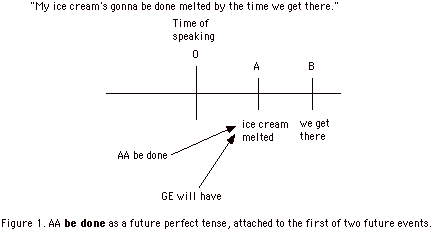
The formal relationship with will have + en is strengthened by the fact that be done is followed by a past participle form. In a number of cases, the regular -ed form is neutralized by the following context, but whenever there is a vowel following, or an irregular past, we find the past form of the participle realized. We do not find forms like We be done wash all the cars. . .
A first indication that AA be done is not equivalent to GE will have comes from utterances that are not located in the future. Both (46) and (47) are not located at any particular time, and refer to a general condition, so that translations with will have are misleading.
(46) They be done spent my money before I even get a look at it.
[Baugh 1983]
(47) It stink in there. You be done spit up before you order.
[of a Chinese restaurant, Dayton 1981]
A number of examples show that AAVE be done is distinct from the GE future perfect in that it does not locate events in the future; in fact, it is free of any reference to absolute location in time. In both (48) and (49), the first event is firmly located in the past, the second in the present.
(48) Here I am talkin' shit. You be done slapped me by now.
['you would have usually walked away from me by now', Dayton 1981]
(49) I coulda be done ran up the steps by now. [Dayton 1981]
A radically different meaning of be done appears in (50). Here the aspect marker is attached to the second of two events, and it cannot be translated by the General English future perfect.
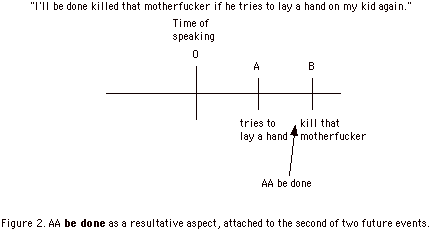
(50) I'll be done killed that motherfucker if he tries to lay a hand on my kid again. [Baugh 1980]
The interpretation of this utterance depends upon an understanding of the exact circumstances in which it was said. During the summer, a number of young men called "Cool Aids" were employed at the pool to keep order. One of them had apparently restrained one of the boys swimming at the pool in a way that his father thought was too rough. He was very angry, and came to the pool for a confrontation. (50) was his summary statement of the situation. Here be done is attached to the second of two events that follow the time of speaking, as shown in Figure 2.
This is a new use developed in AAVE. The meaning that can best be assigned to it combines relative location in time with 'inevitable result', and might then be termed a future resultative. It is then a member of the modal system rather than the aspect system, since it deals with the degree of reality attributed to an event. Dayton traces its development as a separate sense of be done in a large number of examples. Most of them, like (50) are threats or warnings. Dayton points out that although be done does not in itself carry the meaning of a threat, the speech act of threatening is the discourse matrix from which this meaning has arisen.
(51) He [a nephew] knows best not to talk back to me 'cause I be done slapped the little knock kneed thing upside the head.
[19-year-old woman; Dayton 1981]
(52) Get outta my way or I'll be done slid you in the face!
[to a dog, barking; 25-year-old woman; Dayton 1981]
(53) Don't do that 'cause you be done messed up your clothes!
[to cousins 4,5,6 running up and down steps, 27-year-old woman; Dayton 1981]
Among the observations of AAVE made by Rev. Giles, reported by Edwards (1991), there are three examples of be done. Two are single clauses that do not provide enough context to assign them to the types of Figures 1 or 2. The third gives more context:
(54) Stop it dammit before I be done lay down my religion.
This sentence is plainly a threat that the speaker will abandon his usual peaceful conduct and become violent. The aspect marker be done is assigned to the second of two events. Though Edwards states that "this construction is used in [AAVE] as a future perfective", a translation with will have will not do. This example, recorded from Detroit, reinforces the observations made in Los Angeles, New York and Philadelphia which indicate that the resultative construction is quite frequent in AAVE use, and demonstrates again the homogeneity of AAVE throughout the United States.
The typical future location of the two events may reflect the historical origins of be done and its connection with threats and warnings. But Dayton points out that like other AA elements, be done resultative does not essentially carry tense information, and it can be used to refer to inevitable consequence in past, present or future. We find be done used in observations about a general conditions, as in (55):
(55) I don't pay them no attention, child. If you pay them attention, you be done went batty. [Dayton 1981]
In (56) and (57), the first event is not located in the future, but in the general present, while the second is an event that will follow in the future.
(56) I don't want no silver dollars in my possession because I be done dropped them in the machines.
[25-year-old woman, Dayton 1984]
(57) If you love your enemy, they be done eat you alive in this society. [Dayton 1981]
If this is the case, this second be done should be termed simply the resultative. Its relation to its origin in the future perfect is signaled by the fact that the past form of the participle is still retained although the semantics do not focus on the completion or terminal state of the second event to which be done is attached.
The resultative be done is also free of any reference to a specific location in time in relation to the moment of speaking. (58) shows be done attached to the second of two events. Both are contrary-to-fact conditions; the first fact that is hypothetically contradicted is clearly located in the past, while the consequent holds generally for all succeeding times.
(58) If she wasn't spaded, she'd be done got pregnant 'cause she gets out. [Dayton 1981]
A full account of be done in Dayton's data must deal with the extension of this form to cases where only a single event is involved, but the sense of 'inevitability' or 'high probability that the event did or will occur' remains. In some ways, this extension of be done is parallel to the extension of be to 'intensive steady state.' In (59), be done expresses the inevitably of both events; in (60) of a series of events; in (61), of a single event, which has already occurred.
(59) I'm gonna be done hafta went back and finished in eight years. [30-year-old woman; Dayton 1984].
(60) The readin' of the announcements, all that's gonna be done done.
[40-year-old woman; Dayton 1984]
(61) A: Where's Mike?
B:
He be done left. [36-year-old woman; Dayton 1984]
A
complete account of be done must also
consider its compositional character. Do the individual meanings of be and done survive in the combination, and can this combination be used to derive
its meaning? First, it is apparent that the 'habitual' meaning of be does not appear in be done, which normally refers to a single event, not an
indefinite series of events. Mufwene
(p.c.) points out that the use of BE in BE DONE need not carry the semantics of
'habitual' BE, but simply represent the nonfinite form of BE dictated by AAVE
syntax, combining with DONE as a required nonfinite coupla. Indeed, Dayton
(1996) shows many examples where the meaning of invariant BE must be less
specific than 'habitual,' with a core meaning of stativity. The crucial
question then is whether the semantics of DONE can be derived from the DONE the
independent DONE that appears with adverbial syntax.
We
have seen that the 'completive' feature of done does survive in the future perfect be done, but not in the resultative be done. The intensive meaning of done does appear in both uses of be done, and particularly in the resultative, but since we
also find this feature in be, it
may be a parallel development rather than one inherited from done. The feature of moral indignation, which we found
the only semantic characteristic for some uses of done, is often found with be done in combination with other meanings, but never alone,
and it may be regarded as a general characteristic of this type of discourse
rather than one specific to be done.
I have referred here to "two uses" of be done rather than two different aspectual particles. They are in complementary distribution rather than contrast, since the interpretation depends on whether be done is attached to the first or second of two successive events. The general interpretation is that of a sequence of two events, one completed before the other begins, and we may therefore refer to Sequential be done in AAVE.
Non-recent perfective BEEN
In the development of the African-American component of AAVE, one can follow the trajectory of a number of particles from basic grammatical functions found in many languages of the world to a set of highly marked meanings specific to AAVE, distinct from the descriptions we now have of tense, mood and aspect in the languages of the Caribbean, West Africa, or elsewhere. Typical of this trajectory is been, which began as an unstressed, past or anterior pre-verbal particle.[22] In modern AAVE, we do not find this unstressed been, but instead a stressed, low-tone been, with three semantic components:
{1} a condition referred to was true in the past
{2} it has been true for a comparatively long time (non-recent)
{3} it is still true.
All three semantic components are prominent in utterances such as:
(62) They been called the cops, and they're still not here
[Baugh 1983]
(63) She been told him she needed the money. [Baugh 1983]
This use of been always precedes a preterit form of the verb, which in itself may be considered to carry the past tense information {1}. Semantic features {2} and {3} are information conveyed by been itself. When the form with -ed is ambiguously a participle or a preterit verb, then been itself can be heard as equivalent to GE has been with the 's deleted. This is apparently the interpretation made most commonly by whites of expressions such as
(64) She been married.
Rickford 1973 investigated the interpretations of (64) by blacks and whites through the question "Is she still married?" The characteristic white response was "No", since has been without a temporal modifier of duration implies the completion of the action. The majority of blacks responded "Yes", consistent with {3} above. In this situation, been is said to be camouflaged (Spears 1982). However, the simple cases of (62) and (63), and the great majority of other instances of been to follow are unambiguously AA elements. The special AA character of been is particularly evident where it precedes be + ing
(65) I been been knowing Russell. [Baugh 1983]
In other cases, been may follow have (or its equivalent), but cannot be interpreted as a form of have been because it is followed by an active preterit form with the same agent and a different patient, as in They shoulda been realized that. The GE interpretation is possible for they shoulda been told, or they shoulda been instructed.
The semantic feature of an extended period of time{2} is frequently the foregrounded aspect of the meaning. In (66), been is used first by A to assert that people have left.[23] B asks for confirmation, using the perfect adjective already to convey doubt that their leaving is complete at the present time A responds with a re-assertion of been, which here contrasts the 'non-recent' sense of been with the 'recent' sense of already.
(66) A: They been left.
B:
They left already?
A: They been left. [Dayton 1986]
The term 'nonrecent' is simply the negation of the idea that the event is 'new', or 'hot news' in the sense that it can be reported as a current observation. Dayton points out that been is frequently used for cases where a very short period of physical time is psychologically (or socially) long. Stressed been can be used to assert that the speaker has quit a game or made a move in a game directly after he or she has done so.
(67) A: You gonna quit?
B: I been quit. [Member of the Jets, 16, South Harlem]
One consequence of Dayton's long term participant-observation is that we can observe the discourse matrix in which the current semantics of been have arisen. A very common use of been occurs after A notices that B has a new possession. Such observation can play the role of a pre-request for a loan, given the fact that B has just displayed that he or she has resources available. Here the use of been signals (by semantic feature {2}) that the situation observed is not new; that the acquisition has been made some time ago. The inference that new resources are available is negated.
(68) A: New glasses, Darryl?
B: I been had 'em, man. [Dayton 1986]
(69) A: Are those new earrings?
B: I been had 'em. [Dayton 1986]
Again, it is important to note that the frequency of such a discourse context does not imply that it represents the meaning of been, but that the current meaning has developed in that context, just as the resultative be done arose in the context of threats and warnings. Stressed been is of course used in many contexts where no loan is expected or no new resources are involved.
(70) A: That's a new coat, Eddie?
B: I been had that for weeks.
[15-year-old boy to WL, West Philadelphia, 1978]
(71) A: This is Bill.
B: I been know your name.
[6-year-old to WL, West Philadelphia, 1979]
(72) A: Is Donna woke?
B: She been woke. [Dayton 1986]
(73) A: Look how fat she's gettin'. [Dayton 1986]
B: I been fat.
There is often a further social connotation of been that is similar to the use of done to register moral indignation. When someone has just made an observation that they think reports a recent state of affairs, which is actually not recent, the denial can carry a criticism of that person's competence as an observer of the social scene. In (74), C uses been to assert that this state of affairs has been true for such a long time that if A was a competent member of the group, he or she should have known it.
(74) A:. . 'cause CW is our vice president [of the group.]
B: You mean y'all finally realize that?
C: They shoulda been realized that.
[Dayton 1986]
4. An over-all view of the recent development of the AA component.
∑ The recent development of the AA component is sketched in Figure 3. At top are shown the GE tense and aspect elements. Below these are the elements reported for early stages of AAVE that can be considered to have been inherited from a Creole-like grammar, aligned with the GE element that mostly closely corresponds to them. The first row of AAVE elements is assigned the characteristic semantics of Creole systems. Anterior unstressed been corresponds roughly to the GE past, invariant be to the general present copula, perfect done to present perfect have+ed and future perfect be done to future perfect will have+ed.
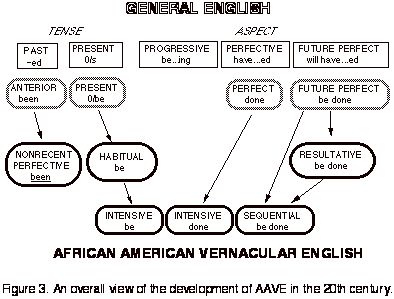
Figure 3 shows the following developments:
Äanterior been has developed to the nonrecent perfective stressed been.
Ägeneral present invariant be has developed to habitual be and then added the sense of 'intensive steady state.'
Äperfect done with the meaning of 'completive' has added the sense of 'intensive' done, and then the modal sense of 'moral indignation'
Äfuture perfect be done has added the 'resultative' sense, which may be combined with the future perfect as a single 'sequential 'use of be done.
This is not intended as a complete view of the AA components of AAVE; I have not included in this picture the role of the modal come in the grammar (Spears 1982), nor the combined form been done (Dayton in progress), nor the grammaticalized adverb steady (Baugh 1984). However, the trajectories shown by the four AA elements discussed here should provide a basis for the fundamental argument to be presented: that AAVE contains two parallel systems with different functional and formal properties.
5. Evidence for coexistent systems in AAVE.
In section 1 we considered the simplest possible approach to the resolution of variation: to assign each variant to an invariant rule of a separate language or dialect. This analytical device is attractive in that it reduces many different kinds of variation to a single kind: the choice of system A or system B at a given point in the utterance. But at the same time, it removes the variation from any further linguistic analysis based on system-internal relations. All variation would then be a form of code-switching, where the system is assumed to be intact, and analytical problems are reduced to finding the set of possible choice points for switching.
The same situation would prevail for the case of coexistent systems, unless we can constrain in some way the choice of one system or the other. What kinds of evidence would tend to support or reject the establishment of two separate systems? The argument of Fries and Pike 1949 depends upon the lack of integration of Spanish borrowings into the phonology of the original language: in other words, the symmetry and simplicity of the phonology can best be maintained by assigning the new elements to a separate, coexistent system. Four conditions that favor the recognition of coexistent systems can be identified:
Condition
I.
The segregation of variants.
The variants of linguistic variables are not evenly distributed across texts or situations, but concentrated in long runs of the same value, so that extended stretches of speech show one value rather than the other.
II. Heterogeneity of constraints.
Variables at the same level of linguistic structure are constrained by radically different types of linguistic factors
III. Absence of phonological conditioning.
A variant alternates with zero or with another variant without any evidence of phonological conditioning.
IV.
Strict Co-Occurrence.
Rules show strict co-occurrence, so that one never applies without the other.
Conversely, one can say that the intimate mixing of variants, parallelism of constraints, the presence of phonological conditioning, and the absence of strict co-occurrence favors the recognition of a single system. Before elucidating the application of these conditions to the recognition of coexistent systems, it will be helpful to state what is meant by the term system. That concept is in fact defined by Principle IV, where systematicity and co-occurrence are coextensive. A minimal system is then a simple combination of two rules, which show the behavior indicated in (6) above. The recognition of a systematic relation here is equivalent to inserting a node in the set of branching rule decisions that eliminates the separate decisions to choose rule A or rule B. For such a specification to be meaningful, A and B must be potentially independent, and not linked by a bleeding or feeding relationship. The clearest cases of such small sub-systems are found in place names which have two competing pronunciations drawn originally from two different languages. Thus the town of Saint Lambert in Quebec is usually pronounced in English as [se$nt'lE$mbˇt], but local residents may also use in English the French pronunciation [s¶$lA$'bEr]. No intermediate combinations are possible: [se$ntA$'bEr], [s¶$'lE$mbˇt], [se$ntlE$m'bEr] are never heard. Here seven features of pronunciation are combined in two co-occurring sets. Once the decision to use the French pronunciation is taken, no further decision points are available. The assignment of the combined variants to the choice of the French subsystem or the English subsystem is obviously an efficient form of description. Furthermore, it captures a generalization about the language that would be difficult to recognize if one did not have available the rules of French pronunciation.[24]
Condition I is the simplest and most obvious condition for the recognition of coexistent systems. If speakers are capable of segregating the values of a number of variables according to the context or topic, the simplest way to describe their behavior is to say that a given style, dialect or language has one set of variants, and another has a different set. We can then say that in one situation, a person speaks French; in another, English. The popular approach to the use of AAVE applies this intuitively: "I can speak Black English or I can speak Standard English." However, empirical study of speakers' behavior has never justified the application of this condition; instead, we find a continuum of styles and an intimate mixing of different values of the variants (inherent variation).[25]
Condition
II applies directly to the AAVE variables that we have been discussing. Finite be,
will, would, have appear at the same level
of linguistic structure as non-finite be, been, done, be done. They all occur as first members of the verb
phrase. But the environments
that govern the appearance of the AA elements have little to do with the
environments that favor the appearance or non-appearance of the finite GE
elements of the auxiliary. There is no evidence that the fine-grained control
of finite be by the preceding
and following environment applies to the AA elements, or that the semantics of
the AA elements is reflected in the use of GE would or have.
Condition III also applies to the recognition of coexistent systems in AAVE. As noted above in the discussion of contraction and deletion of finite be, the presence of phonological conditioning is a critical condition for the assignment of variation to a given level of linguistic structure. It is not obvious a priori that phonological constraints could not affect the variable insertion of morphemes. But many empirical studies converge to show that phonological conditioning applies only to elements that are regularly present in underlying form, while variable insertion of a morpheme does not show such conditioning (Labov 1987).[26] As far as we know, the AA elements in AAVE show no phonological conditioning.[27]
Condition IV is the principal basis for the present proposal for the recognition of two parallel systems in AAVE, which depends upon rules of strict co-occurrence between the AA and GE components.
In the preceding section, evidence was presented that in the AA component, there is no semantic feature of tense: no reference to location in time. But it is not simply the semantic feature of tense that is absent from the AA component. Sentences with these particles do not have the syntactic behavior that is characteristic of GE auxiliaries. The three elements of non-finite syntax mentioned above can be enlarged to a list of six. AA elements are not involved in:
Äauxiliary inversion
Ätag question formation
Änegative placement
Äcliticization on the subject
Äsubject-verb agreement
Äverb phrase deletion.
The absence of these syntactic behaviors from all clauses with AA auxiliary elements contrasts with the clauses that have finite tense markers and follow the patterns of GE syntax. One could attach each of these sets of properties to the dictionary entries for the individual AA elements. But it seems more efficient and realistic to create an AA category and attribute this behavior to membership in this category. The recognition of coexistent systems is equivalent to recognizing a new lexical category in the grammar with associated syntactic and phonological properties. It is not therefore different in kind from the recognition of a category of factive or stative verbs. The crucial difference is that the insertion of this category into the AAVE grammar makes it qualitatively different from the grammars of OAD, where there are no elements that behave with this set of semantic and syntactic properties. We are therefore close to the kind of solution advocated by Mufwene (1992) that recognizes different grammatical options for AAVE from other dialects.
The nature of the strict co-occurrence in AAVE can be sketched in this way. If a speaker of AAVE selects an AA element as the first member of the auxiliary (be, done, be done, been, been done, come), then a wide range of syntactic options are excluded. On the other hand, if the first element of the auxiliary contains a finite tense marker, then those syntactic possibilities are activated.
One might think of this situation as a crimp in the productivity of syntactic rules comparable to the fact that auxiliaries like can, will do not show subject-verb agreement and that others like must do not show tense marking. But the division of AAVE into an AA component and a GE component is more general and sweeping than this, since the two components appear to have two distinct structural analyses. It is not the purpose of this paper to resolve all the problems necessary to arrive at a formal description of the two structures involved.[28] At first glance, it appears that the AA component has fewer of the structures that would motivate the attachment of auxiliaries to nodes higher than the verb phrase itself, so that simpler structures are needed to generate sentences with AA auxiliaries. However, there are a number of issues that must be resolved before a well-motivated decisions can be made in this area.[29]
ÄThough the AA elements may be independent of tense semantically, it is not clear whether they are independent from the syntactic framework that involves tense. Several of the AA elements are closely coupled with formal makers of tense: be done is frequently preceded by the contracted future marker [l] and is almost always followed by an element with the past participle marker, frequently indistinguishable from the preterit (see examples 20-35); done is always coupled with a following preterit form. AA elements do not occur in non-finite positions, in infinitives or gerunds (although habitual be and finite be are neutralized in those positions.)
ÄDone, like steady, has many of the formal properties of an adverb rather than an auxiliary, except for its fixed position at the beginning of the verb phrase. Unlike already, it does not move into other adverbial positions. It is reasonable to ask how the other AA elements like be or been differ from adverbs.
ÄAlthough the syntactic behavior of the AA elements does not require their attachment to a higher node, their semantic content generally modifies the entire verb phrase, a situation that is normally projected from an IP node. We need to know more about the semantic scope of the various AA elements in order to assign them their position in the syntactic structure.
ÄThe fact that be, done, been, and be done do not occur in questions and tag questions may not be a reflection of their status in the syntax so much as their semantic character. These are highly emphatic, foregrounded elements that are incompatible with expressions of doubt or ignorance. In a scale of modality, they are opposed to irrealis as surrealis: they express a higher state of reality than normal. As far as negation is concerned, habitual be is the only one that normally occurs with negation, where it requires do-support: see (11), (12).[30]
In all of these considerations, it appears that habitual be is closer to normal auxiliary status than the others. It is the only one that is negated and receives do-support in negatives and tag questions. It accepts the -s verbal inflection, though there is not yet any clear agreement on whether the bes form is other than a stylistic variant of be.[31] It may well be identified with the invariant be that occurs in non-finite positions in GE. There is no reason to think, therefore, that the AA elements are homogeneous in their structural or semantic behavior. Like any grammatical system, the AA component shows prototypical members that possess all the defining properties, and marginal members that share only some of these properties. In this sense, been and be done are prototypical. While habitual be shares some properties with the GE auxiliary, and done and steady share some properties with the GE adverb, these two are the most easily recognized as distinctively different from any grammatical category in OAD.
Despite these differences, members of the AA component can be characterized together as invariant particles that occur as first members of the verb phrase, convey aspectual and modal meanings but no semantic information on tense, and do not enter into any movement or placement rules of the GE component. They together form a system that is distinct from but coexists with the GE elements of the grammar. From this point on I will therefore refer to the AA system and the GE system of AAVE.
6. The GE system of AAVE
Let us now turn to the GE system of AAVE, which is not by any means to be identified with the GE component of OAD. The majority of the research reports on AAVE, dating from the 1960's, deal with the differences between the AAVE and OAD treatment of consonant codas, liquid vocalization, finite be, the possessive and verbal -s inflections, auxiliary inversion, negative concord, the relative pronoun. The results of this work show that in almost every area, the AAVE version represents a difference in degree rather than kind, that the rules are cut from the same template but in the AAVE version they are extended one or two steps further than the OAD version.
The main interest for the present discussion is in those generalizations that can be extended across the GE and AA systems, differentiating the GE of AAVE from the GE of OAD, and indicating the mutual influence of one AAVE system on the other. We begin with the observation that many syntactic and morphological operations in the GE of OAD depend upon the location of the first member of the finite auxiliary, which contains an obligatory element with whatever tense information is available for that clause. For all speakers of English, the location of this element appears to be problematical when there is no overt expression of the past/present distinction, as with the invariant modals must and ought, and the reduced colloquial forms of is supposed to, has got to. In the colloquial forms of OAD, must and ought appear freely in declarative sentences Thus He must've/musta [mUst¥v/mUst¥] done it is common, but auxiliary inversion and negative placement with these modals are confined to more elevated styles. Must he do it? and He mustn't do it are colloquially realized as Does he hafta/gotta do it and He doesn't hafta/gotta do it. The non-standard forms He don't /'posta do that and He don't gotta do that reflect the difficulty in locating a tense marker when the is of is supposed to and the has of has got to are elided consistently in colloquial speech.
These irregularities in the location of the tense marker are shared by AAVE and OAD. But AAVE speakers show a far more extended set of syntactic phenomena that reflect the difficulty or the impossibility of locating a tense marker in the first member of the auxiliary.
Learners of AAVE therefore have a distinctly different problem than learners of OAD when faced with invariant elements of the English auxiliary, which show no surface realization of the tense marker. This can be seen prominently in the case of double modals. For Southern States English as spoken by whites, there are two modals, and the first element contains the tense marker (Boertien 1979, Di Paolo 1989). In AAVE, the first element appears to function as an adverb without a tense marker. This is shown in (75), where the might of might could is parallel to the might in the second clause. If might functions here as an adverb without a tense marker, we can understand why the negative requires separate do-support in the second clause.
(75) You might could go to the church and pray a little, but you--that still might don't help you.
[12-year-old member of the T-Birds, South Harlem, 1965]
In (76), useta appears to be an adverb in the double modal useta couldn't . In the first sentence, useta is shifted to the front of a declarative sentence, like the adverbs formerly or frequently in formal styles, or lots of times in colloquial styles. Here it plainly does not carry the tense marker.[32]
(76) Useta they looked just alike, but now you can't tell the difference. I useta couldn't figure out which one was Richie and which one was Eddie.
[16-year-old member of the Jets, South Harlem, 1966]
The same difficulty in recognizing tense markers can be seen with single modals. Sentences (77) is produced by the GE system, where a tense marker is supplied for the past progressive. But the tense information, inaudible in useta, is placed on the second element of the auxiliary.
(77) He useta was workin'.
[11-year-old member of the T-Birds, South Harlem, 1965]
In OAD, the tense information in useta is implicitly recognized:
(77a) He useta be workin'.
In (78-81), the same difficulty in locating the tense marker in the invariant form might is shown in do-support for the negative.
(78) They might tell you sump'm and you might don't know. [12-year-old boy in Chicago, 1965]
(79) I might don't understand all of it.
[12-year-old boy in South Harlem, 1965]
(80) She still might don't even like the thing.
[12-year-old boy in South Harlem, 1965]
The same situation prevails for must. In place of mustn't we have must didn't and must don't.
(81) Father: Didn't you read the note?
Son: I read it.
Father: Well you must didn't read it too good!
[Conversation overheard in elevator at 3784 10th Ave., 10/3/67]
(82) I mean--I ain't seen they wardrobe; but if they gon' walk around the street with holes in they pants, they must don't have too much in they wardrobe; right?
[member of the Oscar Brothers, 17, South Harlem, 1966]
There is no doubt that the past/present opposition is as strong in AAVE as in OAD. The difficulty in (81-82) has nothing to do with the semantics of tense, but rather the location of the syntactic tense marker. That difficulty is not limited to the sentence types given in (75-82), but extends to all the sentences types given in (7-74); for these, it is not merely difficult but impossible to find a tense marker. Thus a generalization that extends across the GE and AA systems of AAVE might be stated as:
(83) The tense marker in AAVE is optional, not obligatory.
The term "tense marker" cannot be given a precise syntactic definition at present, given the unanswered questions concerning the formal structure of AAVE outlined above. But (83) captures the common characteristic of the two systems of AAVE, which must be represented in one way or another in the description of the grammar. A second common features of (7-74) also extends to the GE system of AAVE. Given the invariant character of the AA aspect/mood particles, there is no possibility of subject-verb agreement. A large body of research on the GE system of AAVE indicates that subject-verb agreement is marginal. It is fairly consistent in the use of am and is with 1st singular and 3rd singular subjects.[33] Elsewhere, there appears to be no special mark on the third singular, so that the -s which often appears is inserted variably as a morphological entry associated with superposed dialects.[34] A second common generalization across systems is therefore:
(84) AAVE shows no subject-verb agreement, except for present-tense finite be.
7. The current trajectory of AAVE
The most distinctive feature of modern AAVE is the rich development of semantic possibilities in the AA system, possibilities that are unavailable and unknown to speakers of OAD. This semantic efflorescence of the AA system appears to be connected with the fact that the main work of the grammar is done by the GE system of AAVE. The assignment and realization of tense is almost entirely handled by the GE system. This is also true of the main constituents of the aspect system: the progressive and the perfect. The optional AA component can then be said to be freed from the drudgery of every-day grammatical work, and can be specialized to develop the highly colored semantics of social interaction that we have reviewed. This process is the opposite of the semantic bleaching that is typical of grammaticalization: it may be thought of as grammatical colorization.
The social matrix in which this development has taken place is the asymmetric position of African-Americans in American society. White speakers live in one linguistic world, continually illuminated and informed by borrowings and partial glimpses of African-American lexicon and idiom, but with almost no input from the AA system of AAVE.[35] African-Americans live in two worlds. Even if they have no face-to-face contacts with speakers of OAD, they have inherited a GE system that is solidly rooted in the history of English, and indeed preserves many earlier features of English grammar and lexicon that have disappeared in OAD. Even among core members of the AAVE community who have the least contact with OAD, there is continual contact with African-Americans who have been influenced by OAD grammar. Though this may not reduce the further divergence of the AA element, it reinforces those parts of the GE system of AAVE that are held in common with OAD.
One can observe here a parallel with the development of phonology in AAVE. As speakers of AAVE moved to the Northern and Midland cities, they dropped most features of Southern States phonology and merged the rest into a general Northern AA phonology, a phonological koinÈ. [36] But some features of Southern States phonology have been retained as optional markers of style. Thus monophthongization of /ay/ in free position is a constant, unmarked feature of most Southern States dialects. But in Northern varieties of AAVE, monophthongization is affective, as in the contrast of a high [hai] building, and getting high [ha::].
Much of the discussion of the current trajectory of AAVE concerns the issue of divergence and convergence of AAVE with OAD (Labov and Harris 1986, Bailey and Maynor 1987, 1989, Fasold et al. 1987, Butters 1989, Denning 19).[37] The major facts about convergence are well established, through studies of the use of finite be, the pronominal system, and derivational morphology (Vaughn-Cooke 1986). The evidence for divergent processes is accumulating at a considerable rate. Though our first evidence for this dealt with the re-interpretation of verbal -s within the GE system of AAVE in Philadelphia (Myhill and Harris 1986) this has not yet been reported elsewhere. The most important body of evidence on divergence concerns the AA system. The strongest real time evidence concerns the development of habitual be. There is some reason to believe that steady, come and done have long-standing parallels in the Caribbean: when their semantic use in Caribbean grammars is described with a detail comparable to that available for AAVE, we will be better able to judge how recent these developments are in AAVE. The most spectacular semantic developments are found in the prototypical AA aspect forms, been and be done. The inference that these are recent developments is based on the fact that they have not been reported earlier or elsewhere. Given their concentration in highly interactive social exchanges, it is not likely that we will obtain from past records a body of data comparable to that acquired by Baugh and Dayton, but research in Caribbean and West African communities may produce that kind of material and might well modify our current views.
There is much more to be said about the recent history of AAVE. The role of camouflage, as developed by Arthur Spears (1982), plays an important role in these developments. The relations between Gullah and other forms of AAVE must be examined more closely. The presentation here is designed simply to sketch the main lines of development that center on tense and aspect in the AA system and the creation of coexistent systems within the grammar. At present, we have no reason to believe that such coexistent systems existed in the 19th century. To the extent that this description of the past and present forms of AAVE is accurate, the realization of a separate AA system represents the most general form of divergence between AAVE and OAD.
The developments of the past 25 years of research on AAVE have not been unrelated to the original insights of Beryl Bailey, especially her observation of the family resemblance between AAVE and Jamaican Creole, and her insistence on a structural analysis of the relations between dialects. Though the picture I have given is incomplete, I believe that it follows the direction of her thinking in the concluding statement of her 1965 paper:
(85) I have been able to show that subsystems can be abstractedãsubsystems which are so ordered as to make it possible to ignore certain categories which are basic in English.
Thus Bailey clearly foresaw the two themes of this paper: that there is a distinct AA system, and that this system acts on the grammar as a whole to modify certain generalizations of general English grammar.
References
Ash, Sharon, & John Myhill. 1986. Linguistic correlates of inter-ethnic contact. In D. Sankoff (ed.), Diversity and Diachrony. John Benjamins Publishing Co., Amsterdam & Philadelphia, pp. 33-44.
Bailey, Beryl 1965. A new perspective on American Negro dialectology. American Speech 11:171-77.
Bailey, Beryl 1968. Jamaican Creole Syntax. Cambridge: Univ. of Cambridge Press.
Bailey, Guy 1993. A perspective on Afrian-American English. In Dennis Preston (ed)., American Dialect Research. Philadelphia: John Benjamins. Pp. 287-318.
Bailey, Guy and Natalie Maynor 1985a. The present tense of BE in Southern black folk speech. American Speech 60:195-213.
Bailey, Guy and Natalie Maynor 1989. The divergence controversy. American Speech 64:12-39.
Bailey, Guy, & Natalie Maynor. 1987. Decreolization? Language in Society 16:449-473.
Bailey, Guy, Natalie Maynor, and Patricia Cukor-Avila. 1989. Variation in subject-verb concord in Early Modern English. Language Variation and Change 1989:285-301.
Baugh, John . Steady: Progressive Aspect in Black Vernacular English. Ms.
Baugh, John 1979. Linguistic style-shifting in Black English. U. of Pennsylvania dissertation.
Baugh, John 1980. A re-examination of the Black English copula. In W. Labov (ed.), Locating Language in Time and Space. New York: Academic Press. Pp. 83-106.
Baugh, John 1980. A re-examination of the Black English copula. In W. Labov (ed.), Locating Language in Time and Space. New York: Academic Press. Pp. 83-106.
Baugh, John 1984. Steady: progressive aspect in black English. American Speech 50: 3 -12,
Baugh, John. 1983. Black Street Speech: its history, structure and survival. Austin: University of Texas Press.
Bernstein, Cynthia 1988. A variant of the "invariant" BE. American Speech 63:119-124.
Bickerton, Derek. 1974. Dynamics of a Creole System. Cambridge: Cambridge University Press.
Boertien, Harron S. 1979. The Double Modal Construction in Texas. In Smith, Carlota and Susan F. Schmerling (eds.), Texas Linguistic Forum 13: 14-33.
Brewer, Jeutonne 1986. Durative marker or hypercorrection? The case of -s in the WPA Ex-Slave Narratives. In M. Montgomery and G. Bailey (eds.), Language Variety in the South: Perspectives in Black and White. University, Ala: U. of Alabama Press. Pp. 131-148.
Burrowes, Audrey and Richard Allsop. 1983. Barbadian Creole: A note on its social history and structure. In L. Carrington (ed.), Studies in Caribbean Language. St. Augustine, Trinidad: Society for Caribbean Linguistics. Pp. 38-47.
Butters, Ronald R. 1989. The Death of Black English: Convergence and divergence in Black and White vernaculars. Frankfurt: Peter Lang.
Cukor-Avila,
Patricia 1995. The evolution of AAVE in a rural Texas community:an
ethnolinguistic study. U. of
Michigan dissertation
Dayton, Elizabeth 1996.
Grammatical categories of the verb in African American Vernacular English. U.
of Pennsylvania dissertation.
Denning, Keith 1989. Convergenfce with divergence: A sound change in Vernacular Black English. Language Variation and Change 1:145-168.
Di Paolo, Marianna. 1989.Double modals as single lexical items American Speech 64:3, pp. 195-224
Dillard, J. L. 1972. Black English. New York: Random House. Alabama Press. Pp. 151-160.
Dunlap, Howard G. 1977. Some methodological problems in recent investigations of the 0 copula and invariant BE. In D. Shores and C. Hines (ed.), Papers in Linguistic Variation. University, AL: U. of Alabama Press. Pp. 151-160.
Edwards, Walter F. 1991. A comparative description of Guyanese Creole and Black English preverbal aspect marker don. In Walter F. Edwards and Donald Winford (eds.), Verb Phrase Patterns in Black English and Creole. Detroit: Wayne State University Press, 1991. Pp. 240-255.
Edwards, Wa.ter F. and Donald Winford (eds.) 1991. Verb Phrase Patterns in Black English and Creole. Detroit: Wayne State University Press, 1991
Fasold, Ralph W.; Labov, William; Vaughn-Cooke, Fay Boyd; Bailey, Guy; Wolfram, Walt; Spears, Arthur K., and Rickford, John 1987. Are Black and White Vernaculars Diverging? Papers from the NWAVE XIV Panel Discussion. American Speech 62:3-80.
Fasold, Ralph.. 1972. Tense Marking in Black English. Arlington, VA.: Center for Applied Linguistics.
Fasold, Ralph.. 1976. One hundred years from syntax to phonology. Chicago Linguistic Society. Parasession on Diachronic Syntax.
Feagin, Crawford. 1979. Variation and Change in Alabama English. Washington D.C.: Georgetown U. Press.
Fries, Charles C. and Kenneth Pike. 1949. Co-existent phonemic systems. Language 25:29-50.
Guy, Gregory. 1981. Syntactic and phonetic variation in Carioca Portuguese. University of Pennsylvania dissertation.
Herzfeld, Anita 1983. Limon Creole and Panamian Creole: comparison and contrast. In L. Carrington (ed.), Studies in Caribbean Language. St. Augustine, Trinidad: Society for Caribbean Linguistics. Pp. 13-22.
Holm, John 1988. Pidgins and Creoles. Volume 1: Theory and Structure. Cambridge: Cambridge U.P.
Holm, John. 1984. Variability of the copula in Black English and its Creole kin. American Speech 59:291-309.
Holm, John. 1984. Variability of the copula in Black English and its Creole kin. American Speech 59:291-309.
Labov, William and Wendell A. Harris. 1986. De facto segregation of black and white vernaculars. In D. Sankoff (ed.), Diversity and Diachrony. Philadelphia: John Benjamins. Pp. 45-58.
Labov, William and Wendell A. Harris. 1986. De facto segregation of black and white vernaculars. In D. Sankoff (ed.), Diversity and Diachrony. Philadelphia: John Benjamins. Pp. 45-58.
Labov, William, P. Cohen, C. Robins and J. Lewis.. 1968. A study of the non-standard English of Negro and Puerto Rican Speakers in New York City. Cooperative Research Report 3288. Vols I and II. Philadelphia: U.S. Regional Survey (Linguistics Laboratory, U. of Pa.)
Labov, William. 1971. The notion of 'system' in creole languages. In D. Hymes (ed.), Pidginization and Creolization of Languages. Cambridge: Cambridge U. Press. Pp. 447-472.
Labov, William. 1975. Review of R. Fasold, Tense Marking in Black English. Language in Society 4:222-227.
Labov, William. 1987. The interpretation of zeroes. In W. U. Dressler et al (eds.), Phonologica 1984. Proceedings of the Fifth International Phonology Meeting, Eisenstadt. London: Cambridge U.P. Pp. 135-156.
Lefebvre, Claire, HÈlËne Magloire-Holly and Nanie Piou (eds.) 1982. Syntaxe de l'HaÔtien. Ann Arbor: Karoma.
Loman, Bengt 1967. Conversations in a Negro American dialect. Washington. D.C.: Center for Applied Linguistics.
Montgomery, Michael B., & Guy Bailey, eds.,. 1986. Language Variety in the South: Perspectives in Black and White. The University of Alabama Press.
Montgomery, Michael, Janet M. Fuller and Sharon Paparone. 1993. "The Black men has wives and Sweet hearts [and Third Person Plural -s] jest like the white men": Evidence for verbal -s from written documents in 19th century African-American speech. Language Variation and Change 5,3.
Mufwene, Salikoko S. 1992. Why grammars are not monolithic. In D. Brentari, G. Larson and L. MacLeod (eds.), the Joy of GrammarJ. Amsterdam/Philadelphia: J. Benjamins. Pp. 225-250.
Myhill, John 1988. The rise of BE as an aspect marker in the Black English vernacular. American Speech 63:304-325.
Myhill, John 1991. The use of invariant Be with verbal predicates in BEV. In Walter F. Edwards and Donald Winford (eds.), Verb Phrase Patterns in Black English and Creole. Detroit: Wayne State University Press, 1991. Pp. 101-113.
Myhill, John, & Wendell A. Harris.. 1986. The use of the verbal -s inflection in BEV. In D. Sankoff,. ed., Diversity and Diachrony. John Benjamins Publishing Co., Amsterdam & Philadelphia, pp. 25-31.
Poplack, Shana and David Sankoff. 1987. The Philadelphia story in the Spanish Caribbean. American Speech 62:291-314.
Poplack, Shana and Sali Tagliamonte. 1989. There's no tense like the present: Verbal -s inflection in early Black English. Language Variation and Change 1:47-84.
Poplack, Shana and Sali Tagliamonte. 1991. African-American English in the diaspora: Evidence from old-line Nova Scotians. Language Variation and Change 3:301-340.
Rickford, John R. and Faye McNair-Knox 1993. Addressee- and topic-influenced style shift: A quantitative sociolinguistic study. In D. Biber and E. Finegan (eds), Perspectives on register: Situating register variation within sociolinguistics.
Rickford, John R., Arnetha Ball, Renee Blake, Raina Jackson, and Nomi Martin 1991. Rappin on the copula coffin: Theoretical and methodological issues in the analysis of copula variation in African-American Vernacular English. Language Variation and Change 3:103-132.
Rickford, John. 1973. Carrying the new wave into syntax: The case of Black English bin. In R. Fasold and R. Shuy (eds.), Analyzing Variation in Language. Washington, D.C.: Georgetown University Press. Pp. 162-183.
Rickford, John. 1980. How does DOZ disappear? In Richard Day (ed.), Issues in English Creoles: Papers from the 1975 Hawaii Conference. Heidelberg: Julius Groos Verlag. Pp. 77-96.
Rickford, John. 1986. Social contact and linguistic diffusion: Hiberno English and New World Black English. Language 62:245-89.
Rickford, John R. 1992. Grammatical variation and divergence in Vernacular Black English.In M. Gerritsen and D. Stein, Internal and External Factors in Syntactic Change. Berlin/New York: Mouton. Pp, 175-200.
Shepherd, Susan 1981. Modals in Antiguan Creole, child language acquisition, and history. Stanford University dissertation.
Singler, John. 1991. Copula variation in Liberian Settler English and American Black English. In Walter F. Edwards and Donald Winford (eds.), Verb Phrase Patterns in Black English and Creole. Detroit: Wayne State University Press, 1991. Pp. 129-164.
Slave Narratives. . Slave Narratives: a folk history of slavery in the United States from interviews with former slaves (typewritten records prepared by the Federal Writers' Project, 1936-1938, assembled by the Library of Congress Project, Work Projects Administration). Washington, D.C. (Available on microfilm in the Van Pelt Library, Film no. 1448).
Spears, Arthur 1990. Haitian Creole tense, mood and aspect. In J. Singler (ed.), Pidgin and Creole Tense-Mood-Aspect systems. Amsterdam/Philadelphia: J. Benjamins. Pp. 119-142.
Spears, Arthur.. 1982. The Black English semi-auxiliary come. Language 58:850-72.
Stewart, William A. 1967. Sociolinguistic factors in the history of American Negro dialects 1967. The Florida FL Reporter 5:2, Spring.
Stewart, William A. 1971. Observations (1966) on the problems of defining Negro dialect. The Florida FL Reporter, Spring/Fall, pp. 47-49.
Taylor, Douglas 1977. Languages of the West Indies. Baltimore: Johns Hopkins Press.
Torrey, Jane. 1983. Black children's knowledge of standard English. American Educational Research Journal 20:627-643.
Vaughn-Cooke, Fay. 1986. Lexical diffusion: evidence from a decreolizing variety of Black English. In M. Montgomery and G. Bailey (eds.), Language Variety in the South: Perspectives in Black and White. University, AL: U. of Alabama Press. Pp. 111-130.
Viereck, Wolfgang 1988. Invariant BE in an unnoticed source of American early Black English. American Speech 63:291-303.
Winford, Donald 1992. Back to the past: The
BEV/creole connection revisited. Language Variation and Change 4: 311-357.
Winford, Donald 1993. Variability in the use
of the perfect have in Trinidadian English: a problem of categorial and
semantic mismatch. Language Variation and Change 5: 141-187.
Wolfram, Walt and Donna Christian. 1976. Sociolinguistic variables in Appalachian dialects. Washington, D.C.: Center for Applied Linguistics.
Wolfram, Walt. 1969. A Sociolinguistic Description of Detroit Negro Speech. Arlington, VA: Center for Applied Linguistics.
Wolfram, Walt. 1974. The relationship of white Southern speech to vernacular Black English. Language 50:498-527.